


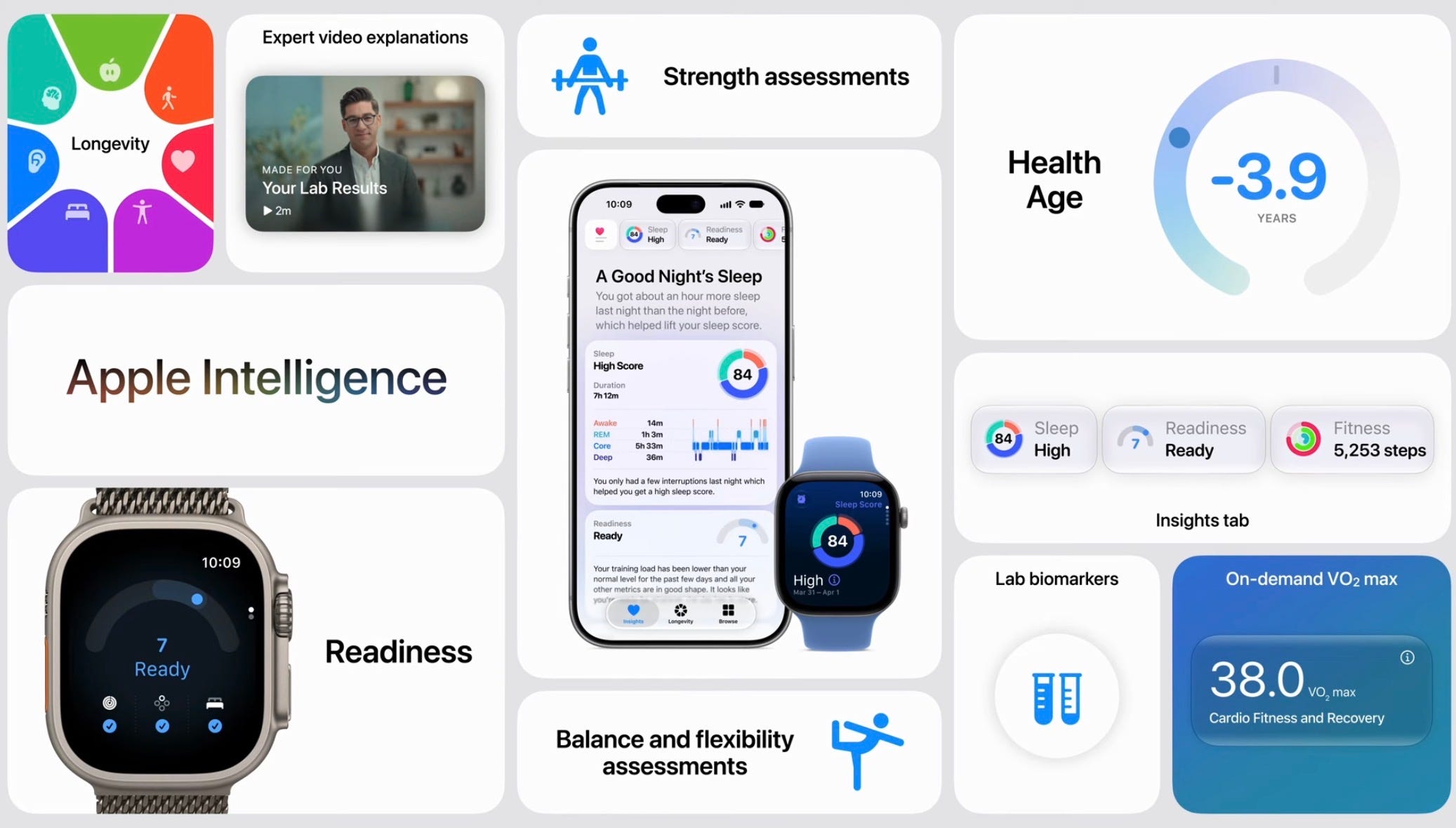
On September 9, Apple announced more health functionality in a single event than most health companies ship in five years. This is the full breakdown, organised by the categories Apple itself now uses, with a coverage map at the end and an summary on what it changes. Every claim links to the original source, so You can go as deep as You want.
The 30-Second Skim
Apple built a Longevity tab. A dedicated section of the Health app covering heart, sleep, mental wellbeing, movement, metabolic health, hearing and nutrition.
Health Age is now a consumer feature. Biological age scoring, from VO2 max, resting heart rate, sleep and HRV, enriched with Your own lab values.
Readiness arrives on the wrist. A 0-10 daily score with four verdicts, built on data from the Apple Heart and Movement Study.
Apple will be selling blood tests. Over 50 biomarkers for $119 through Quest, booked inside the Health app.
The sensor layer got rebuilt. Heart rate every five seconds, HRV up to 24 times more often, and a daytime vitals view alongside the overnight one.
The Sensing Layer: Health Sensing System
Apple Watch Series 12 and Ultra 4 ship a rebuilt sensor stack with new optical and electrical heart sensors, driven by the S11 chip. Larger green LEDs mean heart rate is now measured every five seconds, all day. HRV is measured as often as every five minutes, which Apple describes as 24 times more frequently than before, and it is now split into two variants: Recovery HRV for daily stress and recovery signals, overall HRV for broader cardiovascular context.
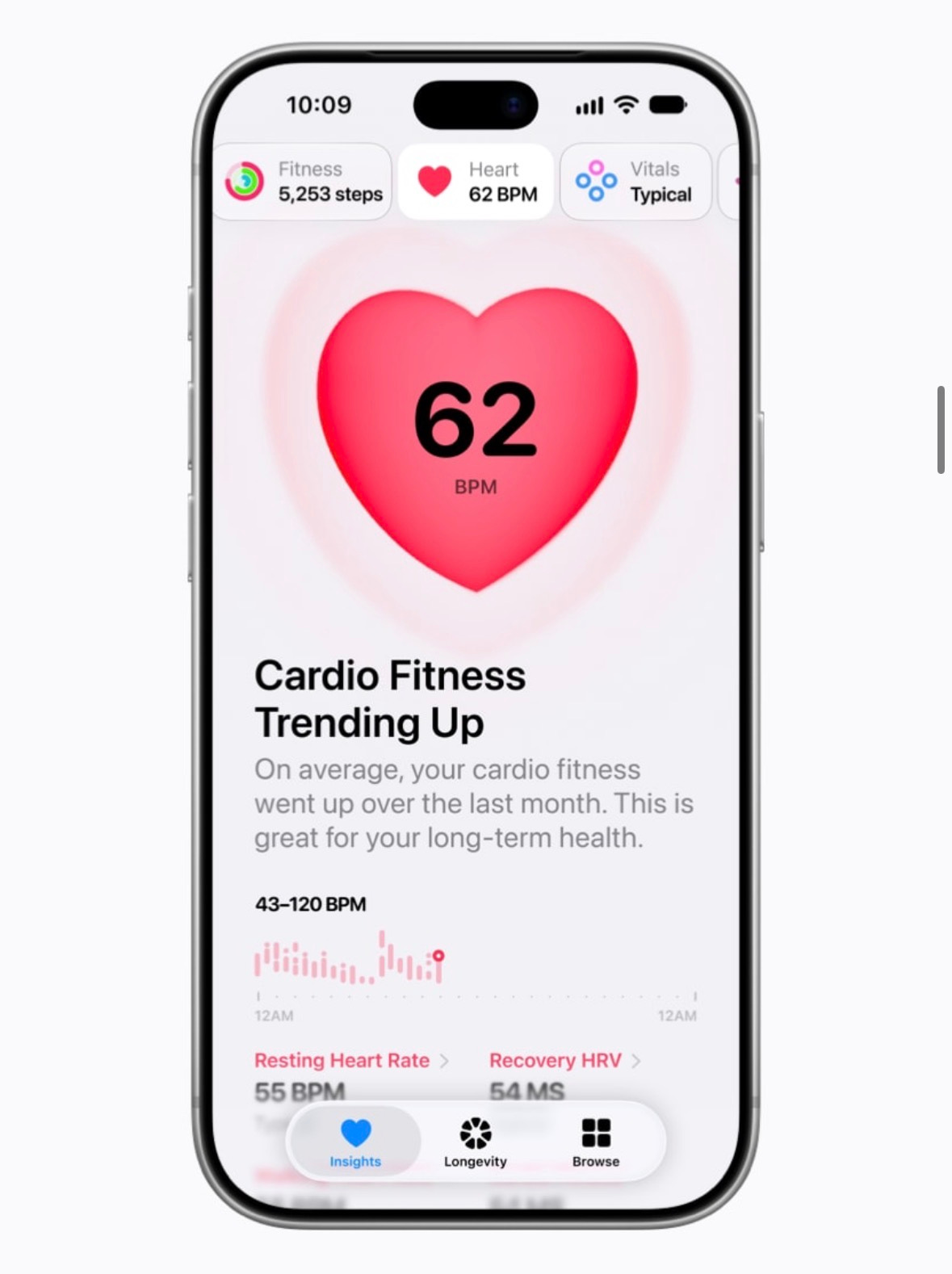
Apple claims the most accurate heart rate sensing in a wearable, based on a study of over 1,000 participants comparing it against leading wearables. Worth knowing: that study was conducted by Apple in July and August 2026 against bestselling wearables available as of June 2026. It is a company study, not independent validation.
Vitals also gets a daytime view alongside the existing overnight one, so shifts can surface before they show up in the night data. Apple notes that the Vitals app is for wellness purposes only, not for medical use.
Health Guy Thoughts: Sampling frequency is the whole story here. Five-second heart rate and five-minute HRV move the Apple Watch from a snapshot device to a continuous one, and continuous data is the raw material every downstream feature.
Read more → Apple Newsroom
Readiness: The Daily Score
Readiness analyses recent activity, training load, vitals and sleep score, then returns a single 0-10 number with one of four recommendations: Recover, Pace Yourself, Ready, or Go For It. It updates through the day as new data arrives, and it shows which factors are driving the score. Apple developed the algorithm using data from the Apple Heart and Movement Study, working with exercise scientists and physicians in-house.
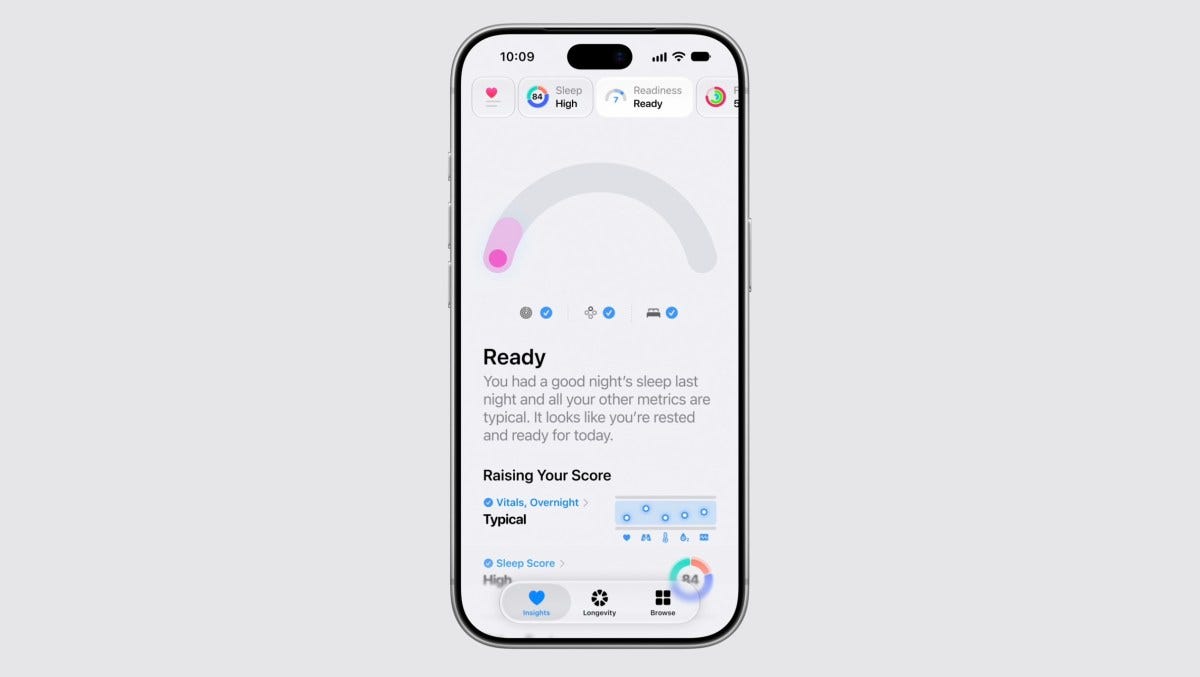
Health Guy Thoughts: This is a direct shot at Oura and Whoop, and the four-verdict design is smarter than a bare number. A score of 6 means nothing to a normal person, but “Pace Yourself” is an instruction. The strategic point is that Apple did not need new science here, it needed the sensor frequency to make an existing category of score credible on its hardware.
Read more → Apple Newsroom
The Insights Tab
The redesigned Health app opens on a new Insights tab: a summary that updates through the day across heart, sleep, readiness, fitness, vitals and cycle tracking, plus a For You section with personalised recommendations and articles based on Your data. Apple’s example is a suggestion to fix Your wind-down routine after a run of late nights.
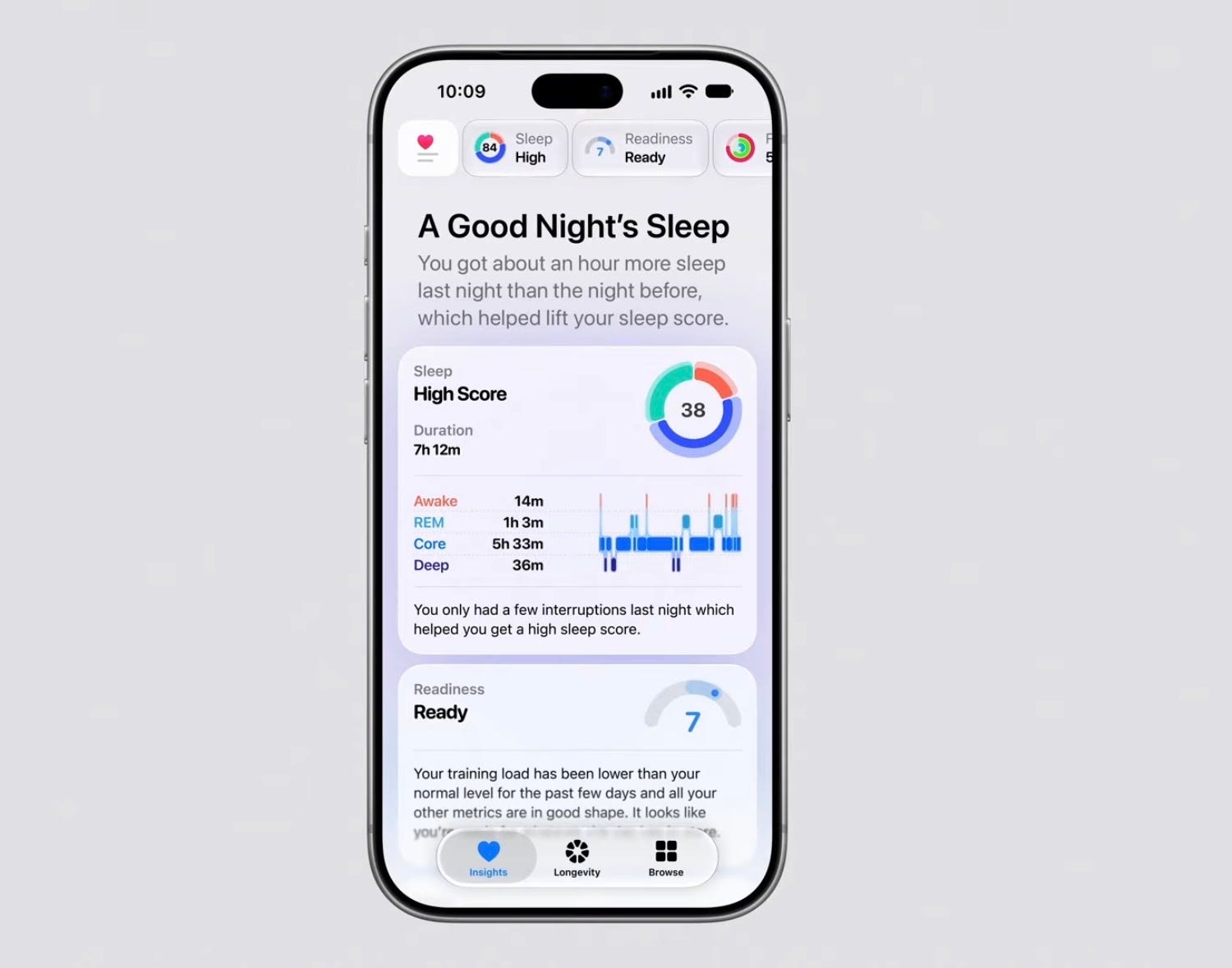
Health Guy Thoughts: This goes in the direction of an interpretation layer, and it is the layer everyone is fighting over. OpenAI, Google and Oura are all building the same thing. Apple’s advantage is that it owns the sensor, the phone and the operating system, so it does not have to ask permission for the data.
Read more → Apple Newsroom
The Longevity Tab and Health Age
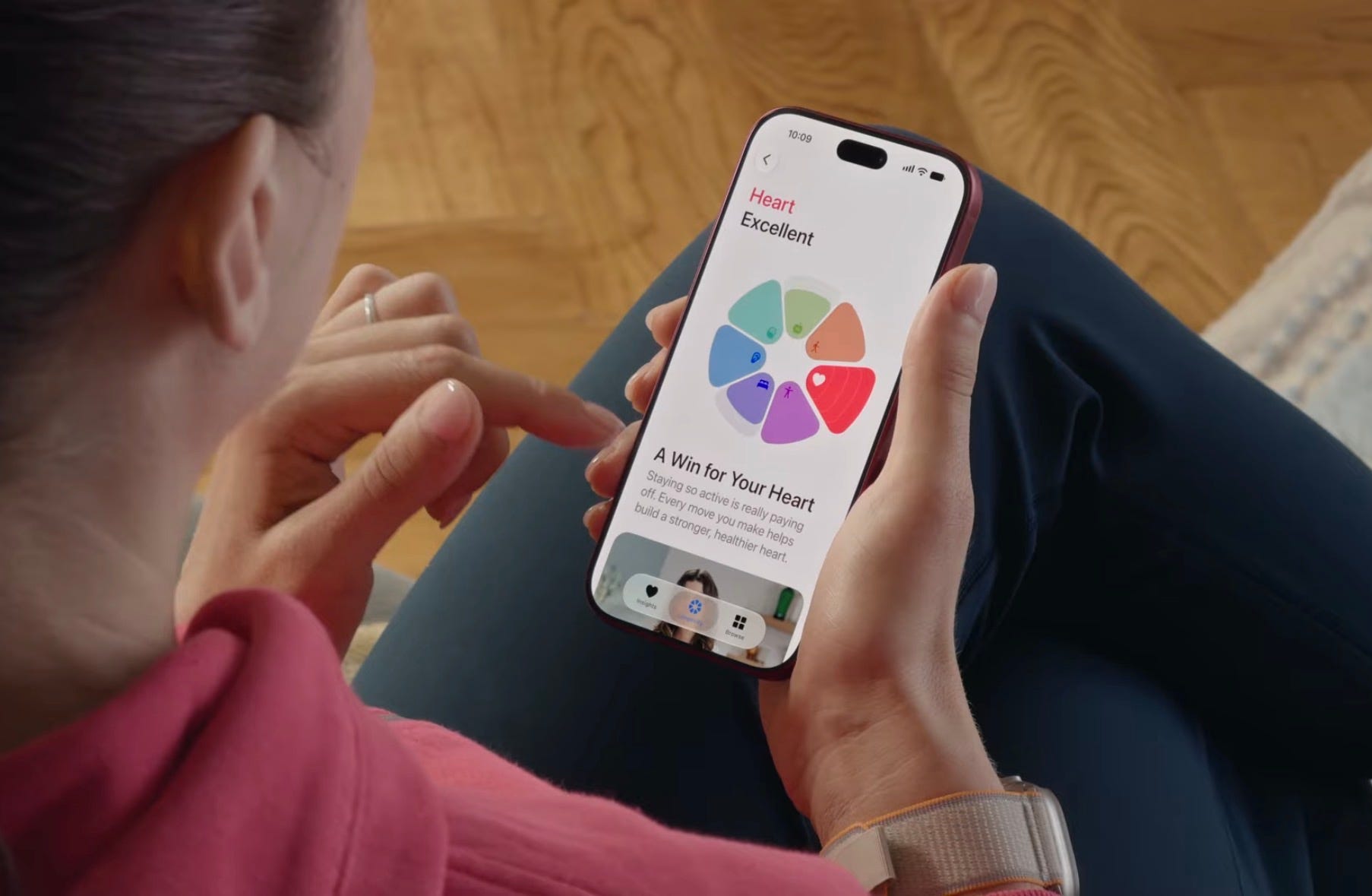
The headline addition. A dedicated Longevity tab analyses longitudinal data across seven areas: heart health, sleep, mental wellbeing, movement health, metabolic health, hearing and nutrition. It draws from iPhone, Apple Watch, AirPods, clinical health records, and third-party apps and devices, and fills in a visualisation showing status per category.
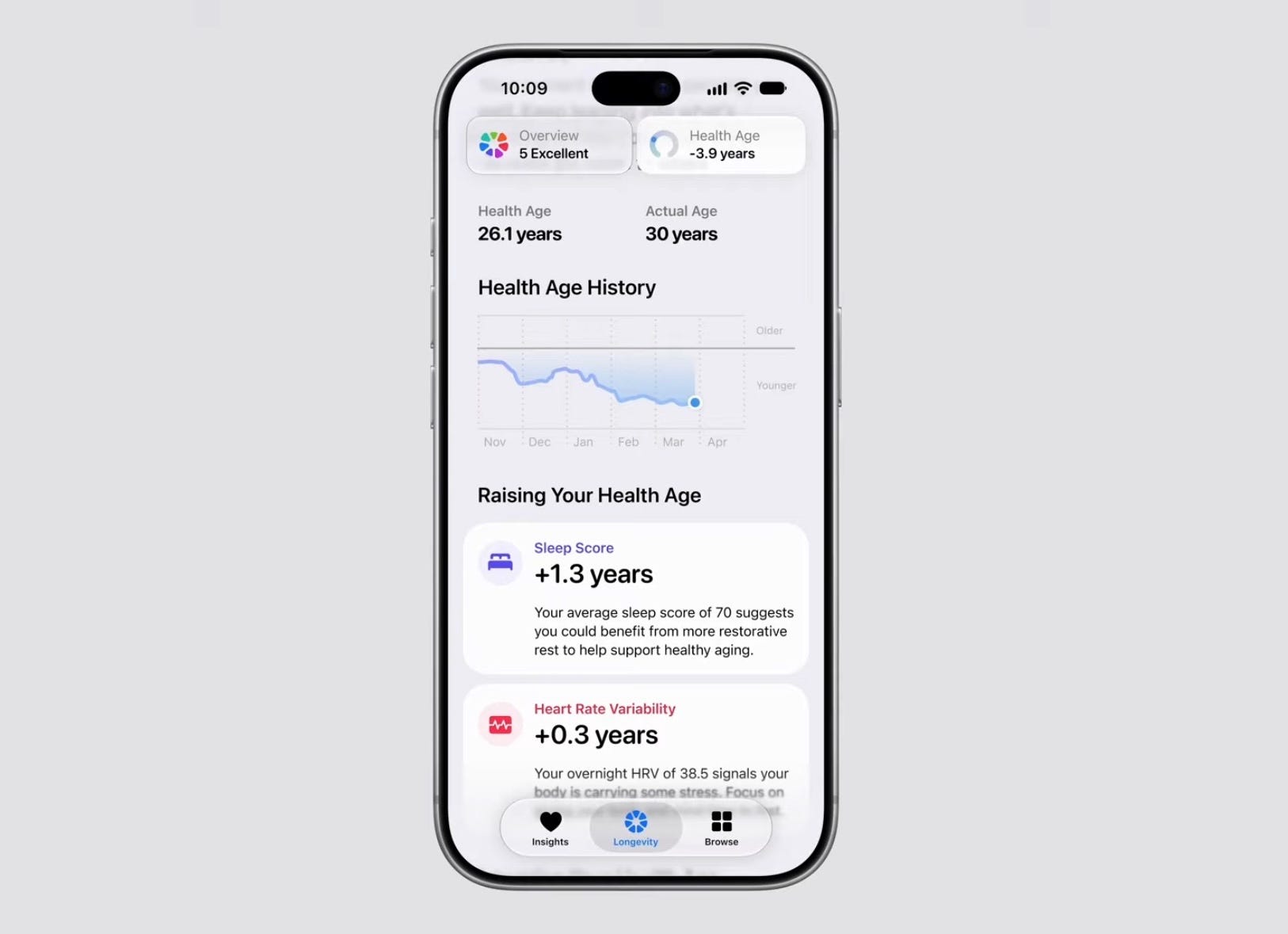
Inside it sits Health Age, which shows how Your metrics track relative to Your chronological age. Apple says the algorithm can factor in VO2 max, resting heart rate, sleep and HRV, and that users can add lab values including A1c and LDL to enrich the analysis. Apple’s own screenshots show a result of minus 3.9 years. Health Age requires an Apple Watch.
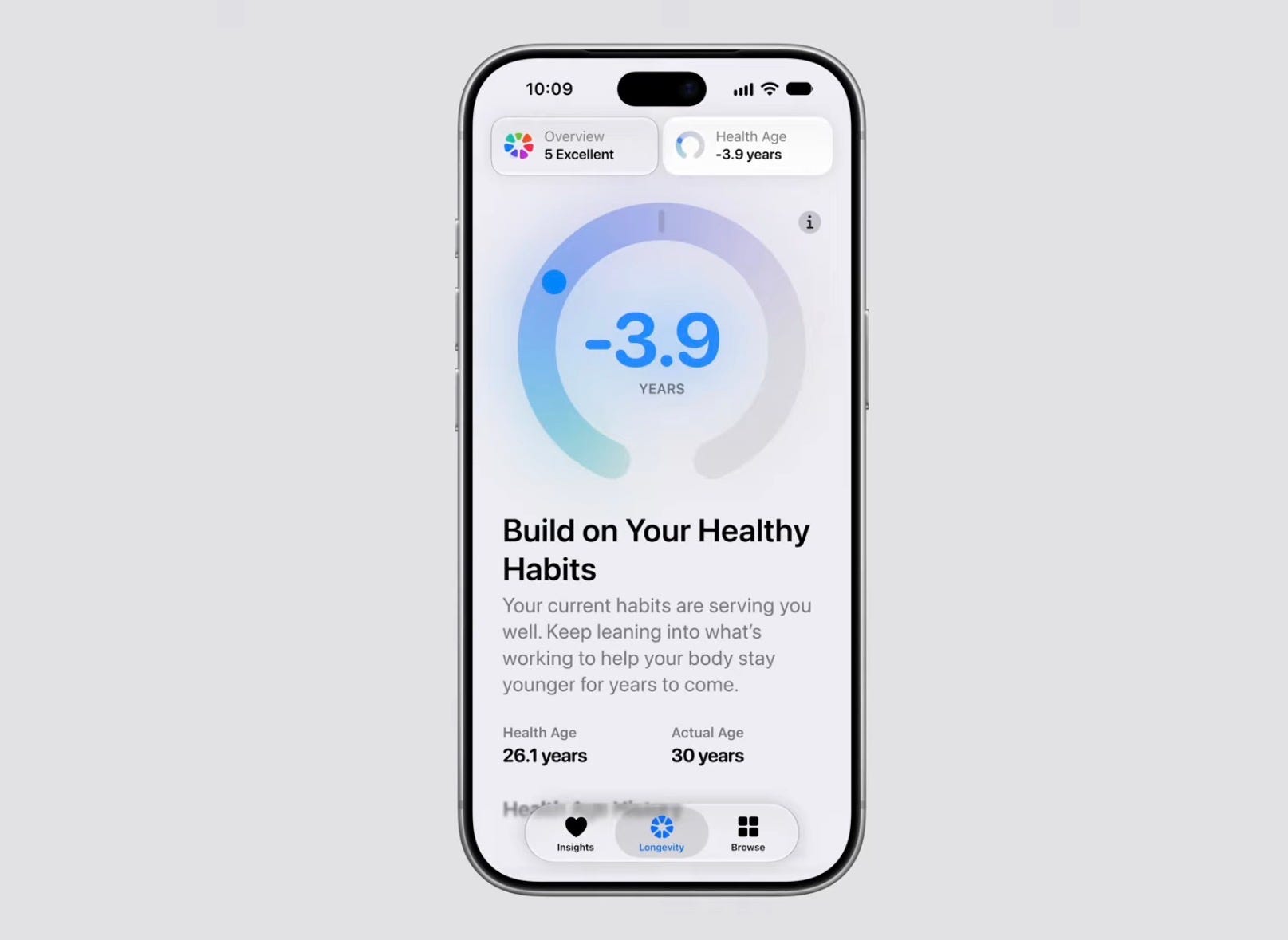
Health Guy Thoughts: Biological age just went from a niche sold by longevity clinics at three-figure prices to a free tab on a device well over 100 million people (by third-party estimates) already wear. What Apple carefully did not say: it describes Health Age as informed by the best available science, but it has published no methodology, cited no validation study, and made no regulatory claim.
Read more → Apple Newsroom
The holistic health overview
Apple did not just add features, it drew a single screen and put seven domains on it: heart health, sleep, mental wellbeing, movement health, metabolic health, hearing and nutrition, each with its own status, all pulled from iPhone, Apple Watch, AirPods, clinical records and third-party apps. That is not a dashboard, it is a definition. Apple is telling several hundred million people what health consists of, and everything that does not appear on that screen is implicitly not part of it.
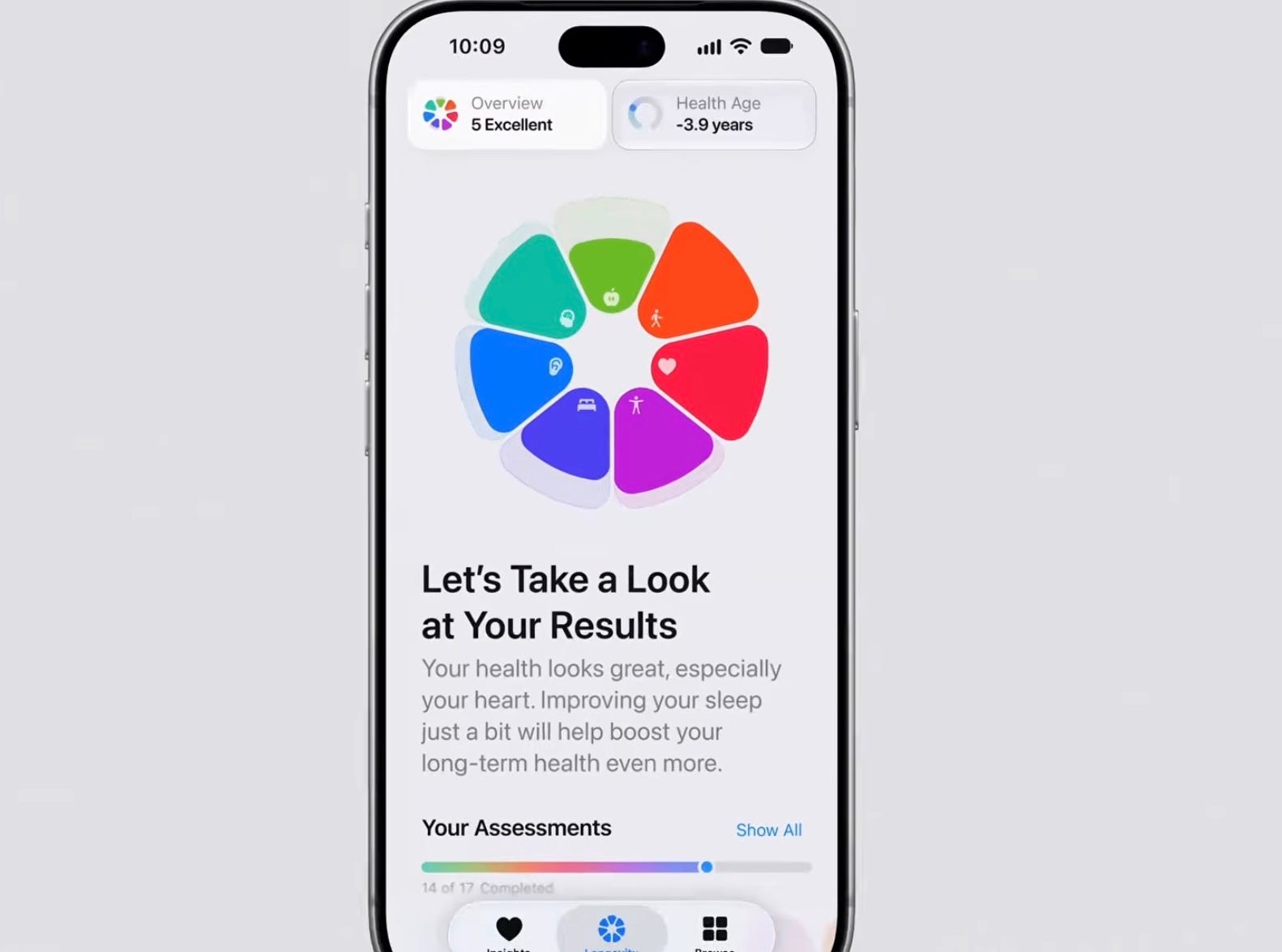
Health Guy Thoughts: This is the part I actually like a lot. Most consumer health products optimise one number and call it wellness. Apple picked the categories a clinician would recognise, gave each of them equal visual weight, and refused to collapse them into a single score at the top. Whoever owns the taxonomy owns the conversation, and Apple just published theirs.
Read more → Apple Newsroom
Movement Evaluations
Users can run in-depth physical assessments at home using the iPhone camera and Apple Watch, measuring flexibility, strength, balance, movement mechanics and VO2 max. Vision-based AI models give real-time audio and visual feedback, the assessments were developed with clinician input, and the whole thing runs on device with no video recorded, stored or shared. Apple frames mobility as a predictor of independence, chronic disease risk and quality of life, and points out that this assessment normally requires a visit to a physiotherapist or exercise physiologist.
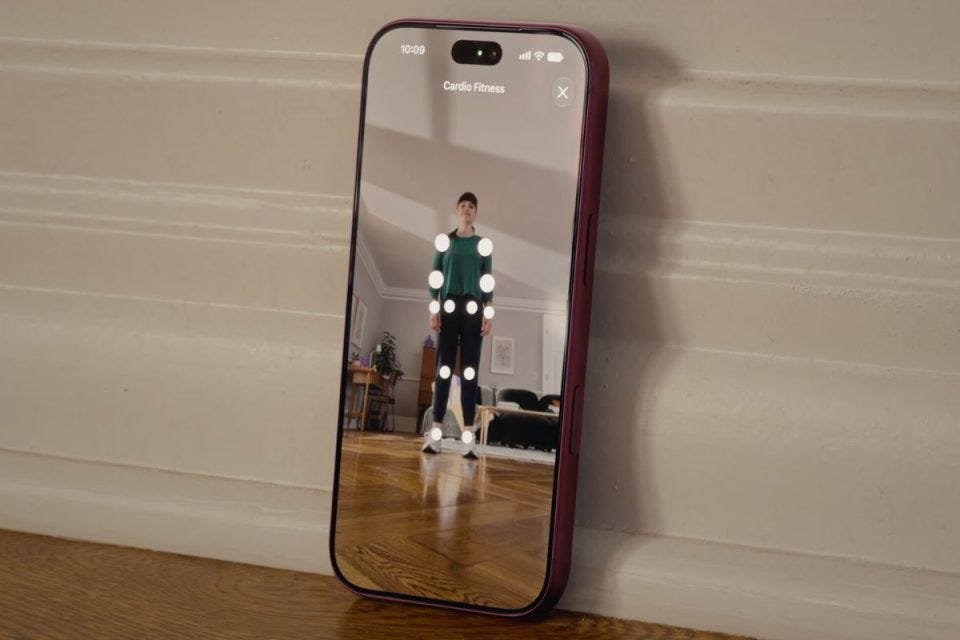
Health Guy Thoughts: On of the boldest feature in the release. Apple is turning the phone camera into an assessment instrument and taking a task that had to be booked, paid for and travelled to, and putting it in the living room for free. Camera-based movement assessment is not new, it is the core of what Hinge Health and Sword Health sell to employers and health plans. What is new is the packaging: no program enrolment, no eligibility check, no extra cost, running on a phone the user already owns.
Read more → Apple Newsroom
Labs: Apple Starts Selling Diagnostics
Users can schedule and purchase a panel of more than 50 key biomarkers for $119 directly inside the Health app, at roughly 2,000 Quest Diagnostics locations in the US. Existing lab results can already be imported and trended.
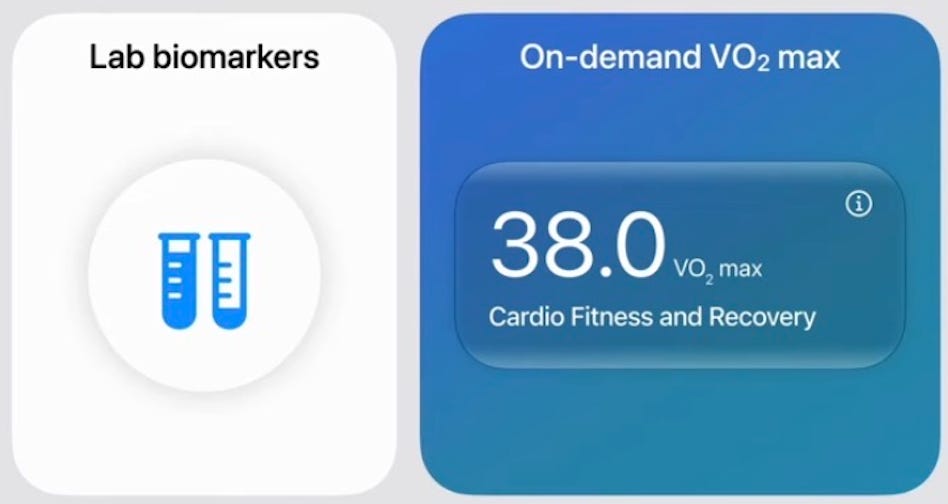
Health Guy Thoughts: Look at whose infrastructure Apple just plugged into. Function Health, one of the best-funded consumer biomarker companies, runs on Quest and books members at more than 2,000 Quest locations. That is the same partner and the same network Apple now sells through, at $119 for a 50-plus marker panel against Function’s $365 annual membership for a wider one. Apple did not enter a new market, it walked into the incumbent’s supply chain and sold a cheaper entry point on top of it. Follow the flywheel: the labs make Health Age better, and a better Health Age sells more labs.
Read more → TechCrunch
Tailored Health Content
After a result lands, the Health app serves videos and articles from Apple Health clinical experts explaining what the number means. Apple’s examples: an expert video on Your LDL after annual labs, or a balance explainer plus a tailored exercise plan after a movement assessment.
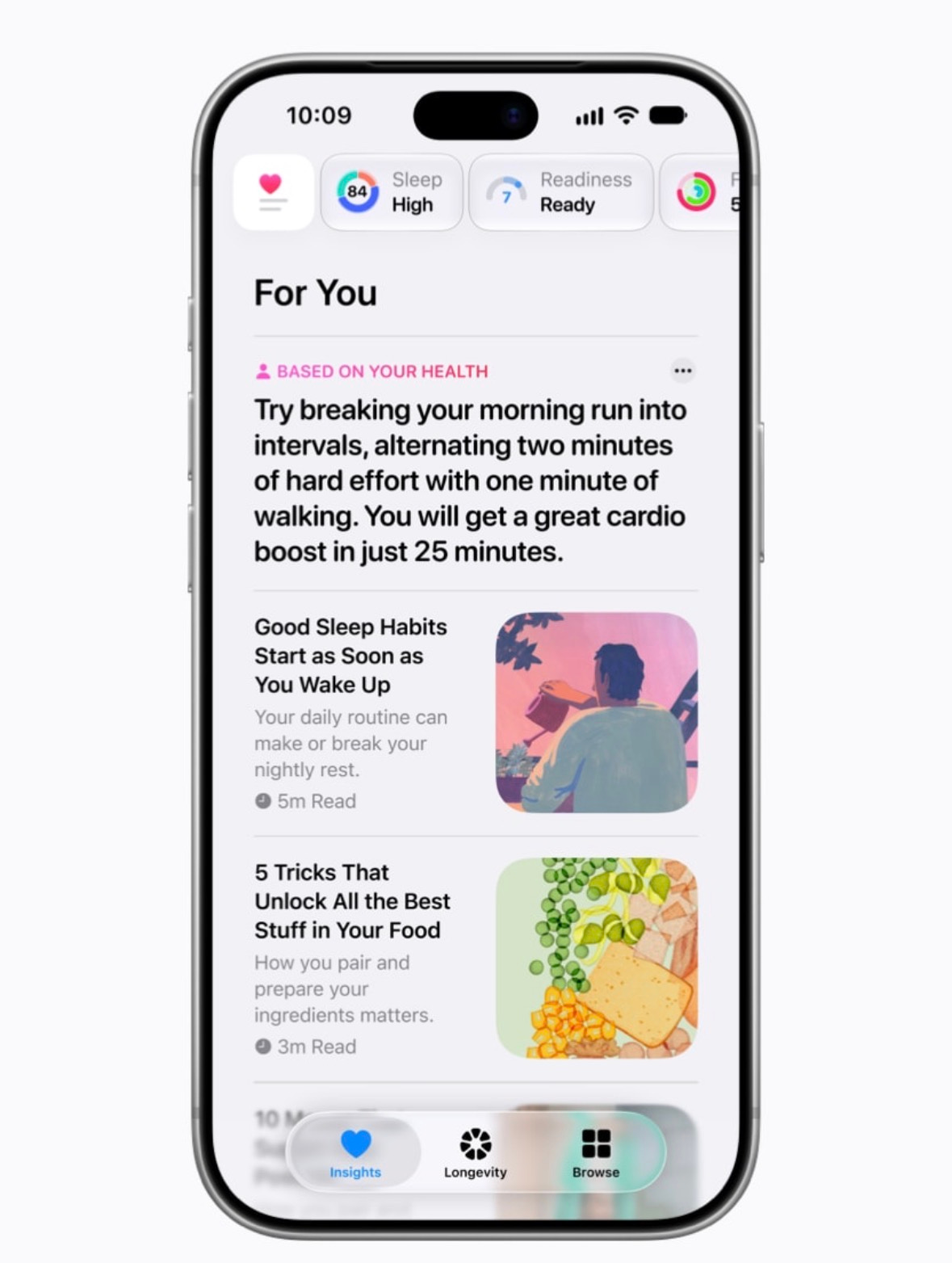
Health Guy Thoughts: Apple is now a health publisher. For everyone building an audience in this space, that is the uncomfortable part of this release. The good news is the obvious limit: Apple will be generic, cautious and universal by necessity, because it is speaking to every user at once. The room left is exactly where independent voices win, in opinion, in specificity, and in saying what Apple’s legal team will never let it say.
Read more → Apple Newsroom
Cycle Tracking: Perimenopause and Menopause
With iOS 27, Cycle Tracking adds support for perimenopause and menopause. Users can log their stage, track symptoms and monitor cycles over time. Users aged 40 and over can receive a notification if a deviation in their logged cycle patterns is suggestive of perimenopause, so they can raise it with a doctor. Logging bleeding after menopause triggers a prompt to speak with a physician. Apple notes Cycle Tracking should not be used as birth control or to diagnose a condition.
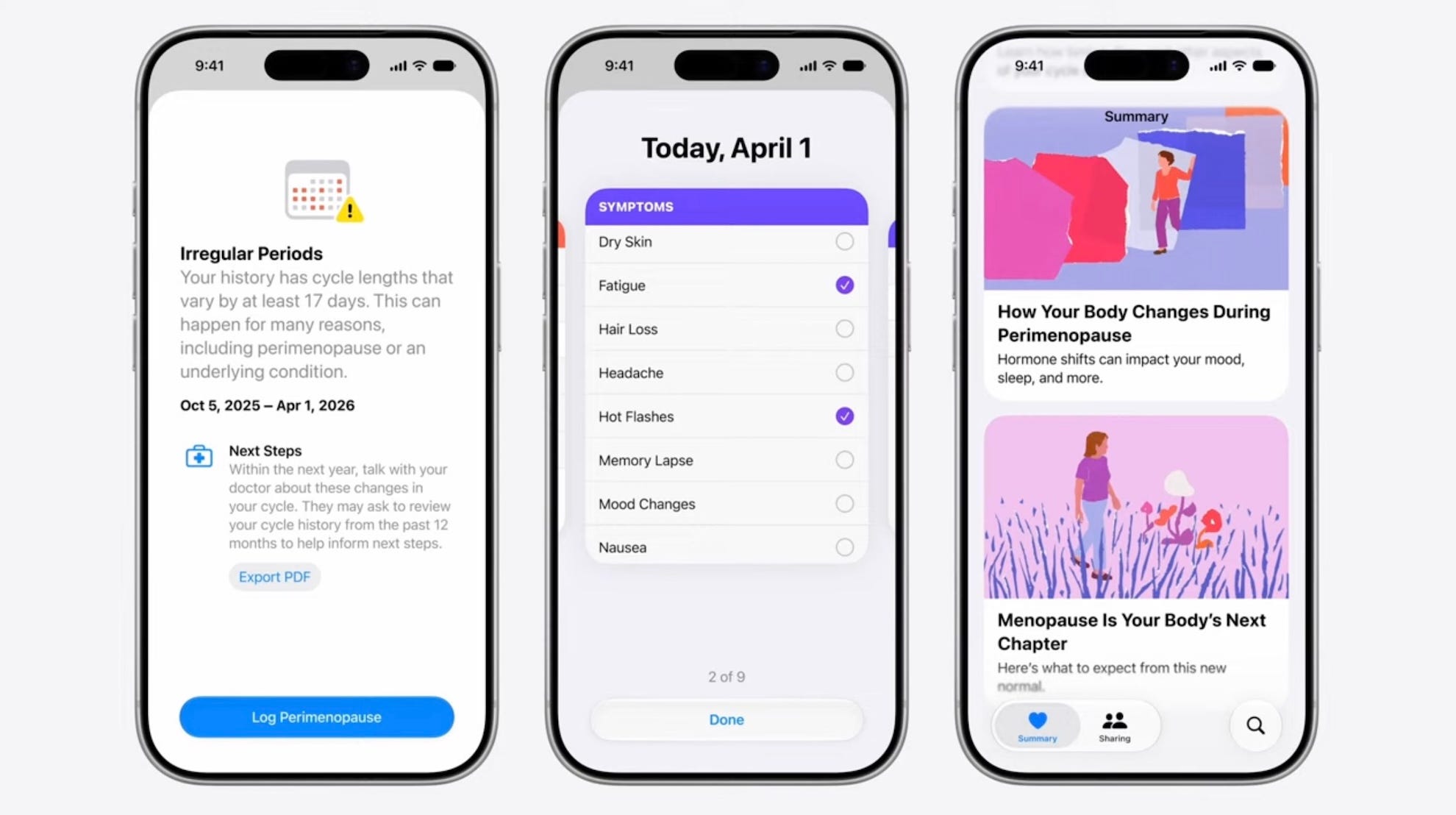
Health Guy Thoughts: A feature we already know in parts from an earlier release. But the most underrated feature in the release. Perimenopause is routinely missed for years because symptoms start long before the last period. A pattern-deviation notification does not diagnose anything, it just gets a woman into a conversation with her doctor earlier. That is exactly the right scope for a consumer device.
Read more → Apple Newsroom
Audio Intelligence and Siri AI
Not health features on paper, but they belong in the picture. The S11 chip enables Sound Recognition on the watch for users who are deaf or hard of hearing, Live Rewind showing the last 15 seconds of a conversation as text, Siri Recap generating high-level conversation summaries, and faster Shazam. Audio is processed in Secure Exclave, a hardware-isolated compartment, and immediately deleted. No recordings are created or stored, speakers are not identified, and Live Rewind plays an audible chime and shows a display indicator when active. Live Rewind and Siri Recap arrive in beta late in 2026, in English first, and not initially in the EU. Siri AI comes to the watch with watchOS 27, also in beta, also not initially in the EU.
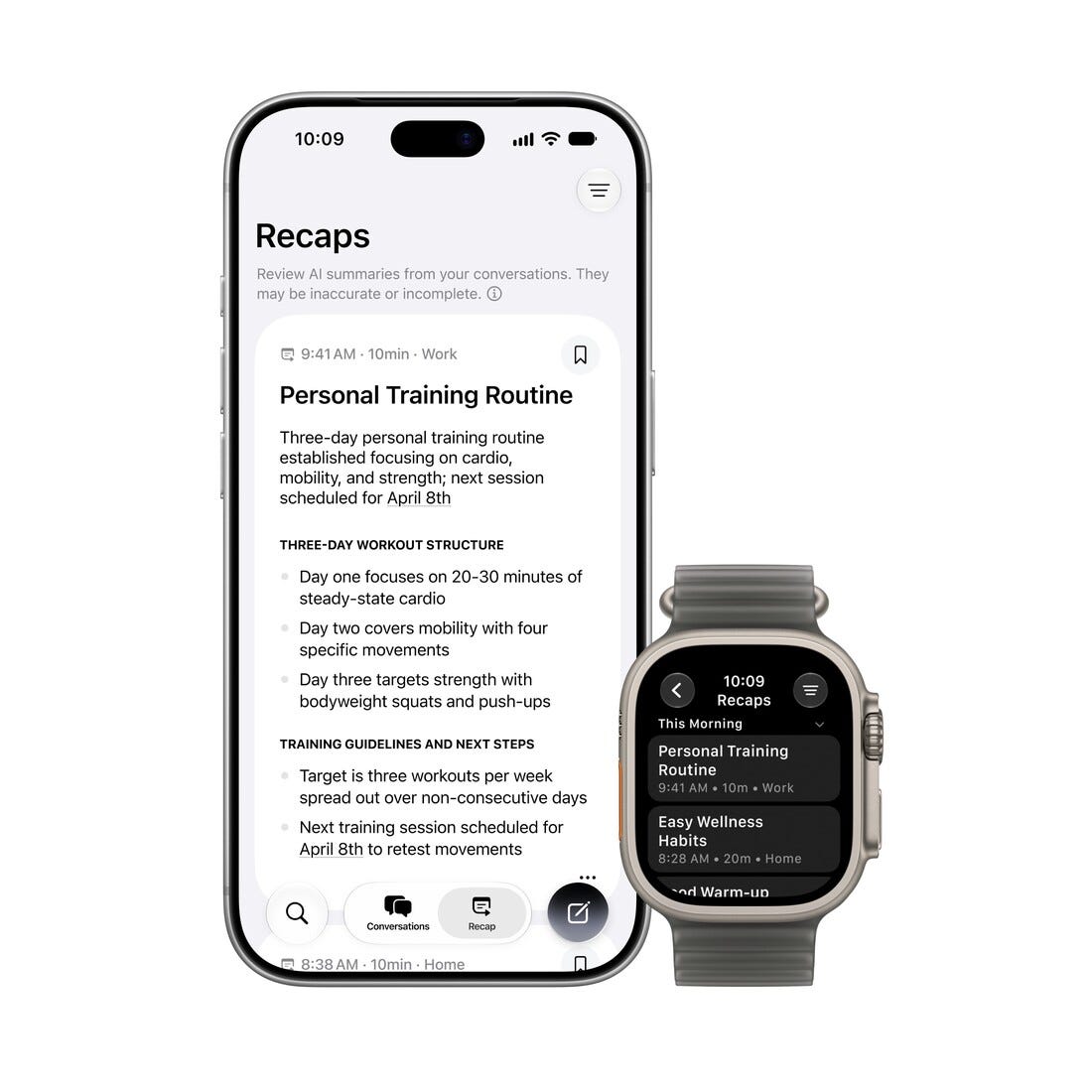
Health Guy Thoughts: Two things matter here. First, accessibility is health, and Sound Recognition on the wrist without a phone nearby is a real gain for hard-of-hearing users. Second, the privacy architecture is a competitive weapon. A hardware-isolated audio compartment is expensive and hard to copy, and it is exactly the argument Apple will make when the always-listening question arrives.
Read more → Apple Newsroom
Everything Else
Step tracking rebuilt with new machine learning models, which Apple claims makes it the most accurate of any smartwatch, again on a company-run test. Ten hours of workout battery, 25 percent more than the previous model, and 15 minutes of charging for up to 12 hours. Workout Buddy runs on the watch without an iPhone nearby, now in English and Spanish. GymKit expands so AirPods Pro 3 users can push heart rate to treadmills and indoor bikes. Series 12 starts at $399, in stores September 18. watchOS 27 arrives September 14.
The Coverage Map: What Apple Now Owns
Apple now sits on five layers at once.
Sensing. Heart rate, HRV, sleep, movement, plus the existing ECG app and sleep apnea notifications, all on Apple’s own silicon. Hearing sits in the Longevity tab as a category but the sensing for it runs through AirPods, not the watch.
Interpretation. Readiness, sleep score, Vitals, the Insights tab, Health Age. Owned, and now powered by Apple Intelligence.
Assessment. At-home movement evaluations for flexibility, strength, balance, mechanics and VO2 max. New for Apple, and the first time this sits in a consumer device for free rather than inside an employer-sponsored program.
Diagnostics. Over 50 biomarkers for $119 through Quest, plus import of existing labs and clinical records. New, and priced aggressively.
Education. Expert video and article content triggered by Your own results, plus tailored exercise plans. New.
And the seven categories inside the Longevity tab, heart, sleep, mental wellbeing, movement, metabolic health, hearing, nutrition, are effectively a map of consumer health as a whole. Apple has drawn a box around the entire category and put its name on it.
What Apple still does not have. No care pathway. There is no clinician as escalation path, no telehealth, no prescription, no treatment. Oura and Whoop both moved that way this year and Apple did not. No regulatory claim on the new scores: Vitals is explicitly wellness-only, Health Age carries no clearance, and none of this diagnoses anything. And no global launch: the Health app redesign starts in US English later this year, labs are US-only, and both Siri AI and Audio Intelligence skip the EU at launch.
What This Means
Three reads for anyone building in this market.
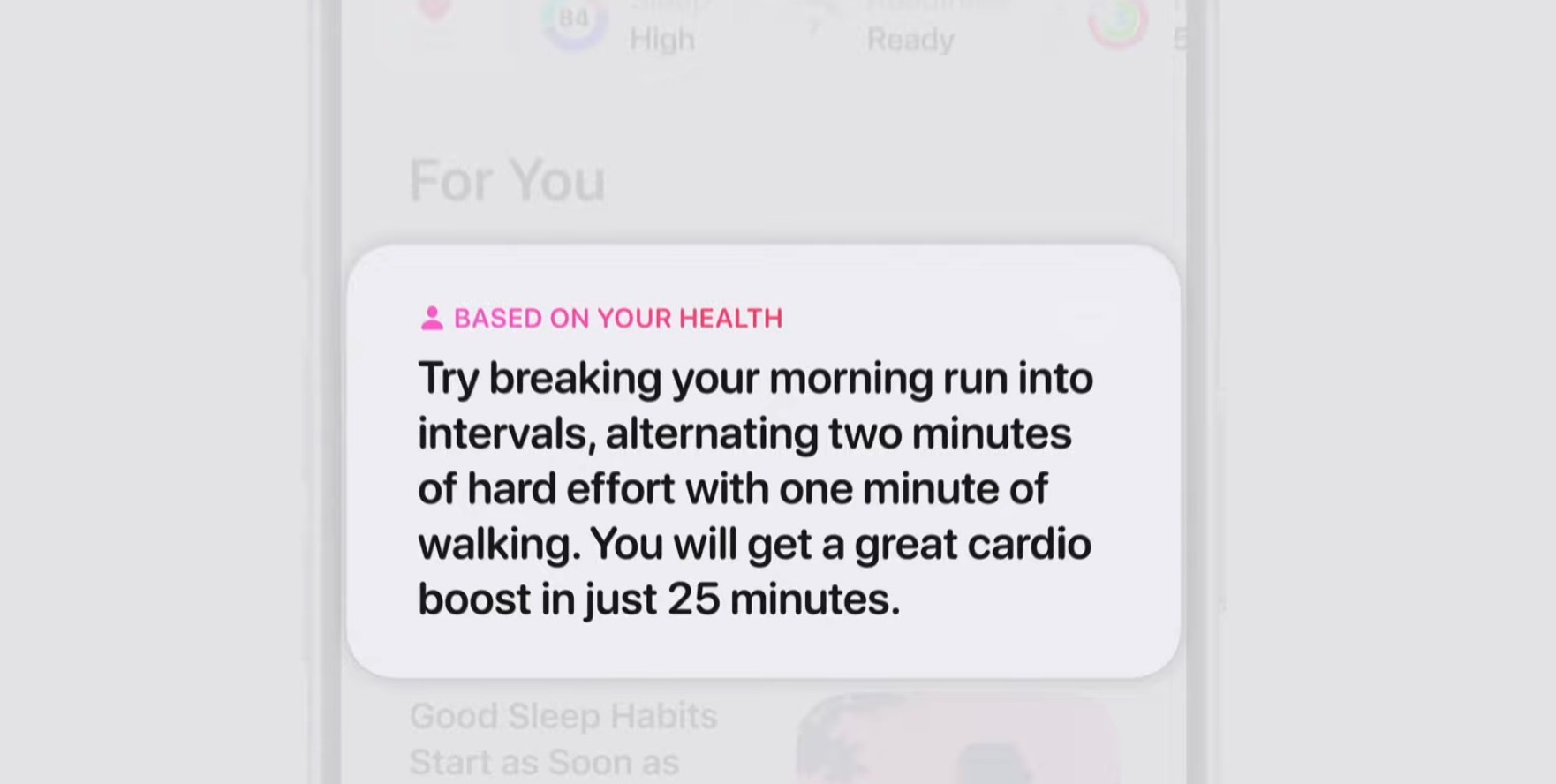
The interpretation layer is now table stakes, not a product. For three years the pitch in consumer health has been “we turn Your data into insight.” Apple just shipped that for free, across seven categories at once, on a watch with an estimated installed base well above 100 million. Any company whose entire value sits between the sensor and the summary now has a serious problem. The defensible positions moved to the two ends: proprietary sensing that Apple does not have, or a care pathway that Apple has deliberately not built.
Diagnostics just got repriced, and biological age got commoditised. A $119 panel of 50-plus biomarkers, bookable in an app people already have and drawn at the same Quest network the incumbents use, is not a product launch, it is a floor. Function Health charges $365 a year and Superpower $349 for wider panels with clinician review, and both now have to answer a new question: what exactly is the member paying for that Apple is not doing for free. The honest answers do exist, deeper panels, real clinical interpretation, physician oversight, a care plan someone is accountable for, and those answers are worth building around. Convenient access to a blood draw is no longer one of them.
The gap Apple left open is trust and specificity. Apple will tell a very large number of people that their Health Age is minus 3.9 years, without publishing a methodology, without citing a validation study, and without a regulatory claim, and the number will be believed as if it came from a lab. That is the opportunity and the risk in the same sentence. The opportunity for operators and for anyone with genuine expertise is to be the layer that explains what these scores actually rest on, where they break, and what to do when the number moves. Apple can build the instrument. It cannot, for legal reasons, tell You what it means for You.
The market moved this week from measuring health to scoring it. Scores are motivating, sticky and enormously commercial. They are also, for now, unvalidated. Build accordingly.
The one newsletter you need to understand what moved across Health & Life Science and what it means.
Before You Go
If this saved You time this week, forward it to one person who needs to stay current on health and life science.
Reply with one line: what did I miss? The best newsletters are built with their readers.
And if Your team wants this market intelligence translated into strategy, a workshop or a board-level sparring session, that is exactly what the www.venture-institute.com does.
Healthcare Minutes is part of www.health-guy.com. Written by Leonard Rinser.